Sunday, October 14, 2012

Coping...when a parent is abroad

"How do you help young children cope when a parent is abroad?"

This is what I found myself googling two weeks ago when my husband was away on a ten-day trip to China (see my previous post on his trip).  This was a trip to visit family: his mom and dad, grandparents, aunts and uncles, and cousins, and to also do some genealogy research with some distant relations whom he met for the first time.

This was the first time since we were married ten years ago that he made this trip by himself.  The last time we went to China, all four of us travelled together. Our daughter was four, our son was one, and the trip was more difficult than we had imagined (with the twelve-hour time difference, unexpected illnesses, traveling hardships, etc...). This time, my husband would go by himself so he could cover more ground and see more relatives in a shorter period of time. It would be easier...

...or so we thought.

The day my husband left, I witnessed a huge change in my three-year-old son's behavior.  My normally happy, goofy boy became defiant and angry, ready to throw a major temper tantrum at the mere suggestion of a purely normal activity (such as getting into the car). 

This behavior continued non-stop for four days, when during his longest, angriest tantrum he began screaming, "I want to go to China with Daddy" and "Why didn't Daddy take me to China too?" 

Gulp. I suddenly realized that this wasn't a normal tantrum phase as previously thought. My son was experiencing real anger and sadness because his daddy was in China and he was not. 

How could I help him? My mind frantically searched for something that might bring him comfort. After drying our tears (seeing my son cry for his daddy broke my heart), I suggested that we go home and that he draw a picture of how he felt. 


To my surprise, he willingly got in the car, and after we got home, spent about 20 minutes drawing his picture (right).

Later that evening he was able to share his picture with his daddy on Skype. He explained how he was sad but all of the people in China were happy.  
My poor little guy!


The next day he told me that he was going to write a letter to his daddy explaining how he felt sad and angry.  After finishing his "writing," I had him "read" his letter to me and I wrote down what he said (he's just learning to write the alphabet so his letter required adult interpretation).  Again, we turned to Skype as a means to share these words "face-to-face."

From this point on,  I began to see gradual improvements in my son's mood. He still  felt angry or sad at times, but instead of immediately throwing a tantrum, he was able to tell me that he was angry and sad that Daddy was in China. By the time my husband returned on the tenth day, my son had returned to his happy, silly self, and I breathed a huge sigh of relief.

Both my husband and I had thought that this trip would be easier than those in the past because he would be making the trip alone. We had never anticipated that this actually might be harder for our kids and could lead to complex feelings of sadness and anger because they were left behind. 

This trip was an eye-opener for me, and will certainly give us something to think about when we plan our next trip. It wouldn't surprise me if we make the next trip together!


Wednesday, September 26, 2012

Chinese Characters--look for the story


I’m teaching my daughter and her friend how to write Chinese characters as part of their weekly lesson (see my post from last week about our new Chinese language co-op).  Since they are also encountering new vocab and grammar patterns almost every week, I try to introduce only one or two new characters at a time.

Instead of forcing my daughter and her friend to copy the new characters hundreds of times (which was how I learned...and then promptly forgot), I look for creative ways to keep the characters fresh and alive in their minds.  One idea that I've been looking into lately is  imagining the character as part of a larger drawing and/or making up a story about that drawing. 


Illustrator, author, and graphic designer Christoph Niemann does this brilliantly in The Pet Dragon. He illustrates the meaning of Chinese characters by making them part of his illustrations for a story about a little girl named Lin Lin and the little dragon she receives as a gift. For some characters, Niemann employs the historical meaning of the pictograph (i.e. the character for “person” is meant to look like a walking person; Niemann draws this  character on top of a walking Lin).  But for others, Niemann creates his own interpretations of characters (i.e. the character fu, father, becomes Lin’s angry father’s eyebrows and moustache).  

Niemann is upfront with his intentions for this book—it is not to teach Chinese but to inspire kids to learn more. And that's what I loved about the book: it inspired me to look for the story, whether intentioned or unintended, in the characters. By asking my daughter and her friend to help create the story, this will help them remember the characteror at least that's my theory.  I'll let you know how it turns out!

How do you help kids remember Chinese characters?

Thursday, September 20, 2012

Will she ever dream in Chinese?


We’ve begun a new year of Chinese lessons in our household. This year my friend and I are trying something entirely new. We’ve formed a small co-op and are team-teaching our girls Chinese.  With my background in the Chinese language, I contribute to the linguistic side of our lessons and she, the master teacher, finds new and creative ways to make our lessons “stick.”

This past week, I watched my daughter process a sentence from a story I was telling them.  “Lùlù yào yī zhǐ xiǎo gǒu” (Lulu wants a small dog), I stated.  

She looked at me quizzically, “Huh?” and held up her index finger, which is our sign for "please say it one more time.”

Lùlù yào yī zhǐ xiǎo gǒu,” I repeated. 

She looked out of the corner of her eye thoughtfully and held up two fingers (the sign for two more repeats). 

Lùlù yào,” I broke the sentence up into fragments. “Lulu wants,” she translated out loud.

 “yī zhǐ,” I continued.

“That means one,” she said.

xiǎo gǒu,” I finished.

Xiǎo is little and gǒu means dog,” she responded.

“So what did I say?” I asked again.

“Lulu wants a small dog,” she beamed.  And I did too, because she patiently analyzed the sentence, bit by bit, and--despite being confused at first--successfully completed the translation.

Later that night,  I wondered, "Will she ever dream in Chinese?" Will she, at some point, become  fluent in this language that right now feels so strange in her mouth and mind? And when will she be able to transition from translating word for word to thinking and responding automatically in Chinese?

Do I even remember when this happened for me?

I remember sitting in first year Chinese in college, hearing my teacher speak and trying desperately to make the cogs in my brain turn faster.  During the second year, my teacher spoke Chinese only during class and although I quickly began understanding what he said, I struggled in my responses, stuttering and sputtering, as I tried to first translate in my mind what I wanted to say from English to Chinese, and then repeat this phrase as imagined out loud.  At some point during the following five years, my brain made the switch and I started to respond, think, and yes, even dream in Chinese.

I know that my heart will swell with pride if and when my daughter gets to this point, but for the time being, I am thrilled that she is learning the language, even if it is bit by bit.


***The title for this post is from a book I'm currently reading by linguist Deborah Fallows, which is about her experience as an American in China, as seen through the lens of learning the Chinese language. 

Saturday, September 8, 2012

Ten Years and Counting


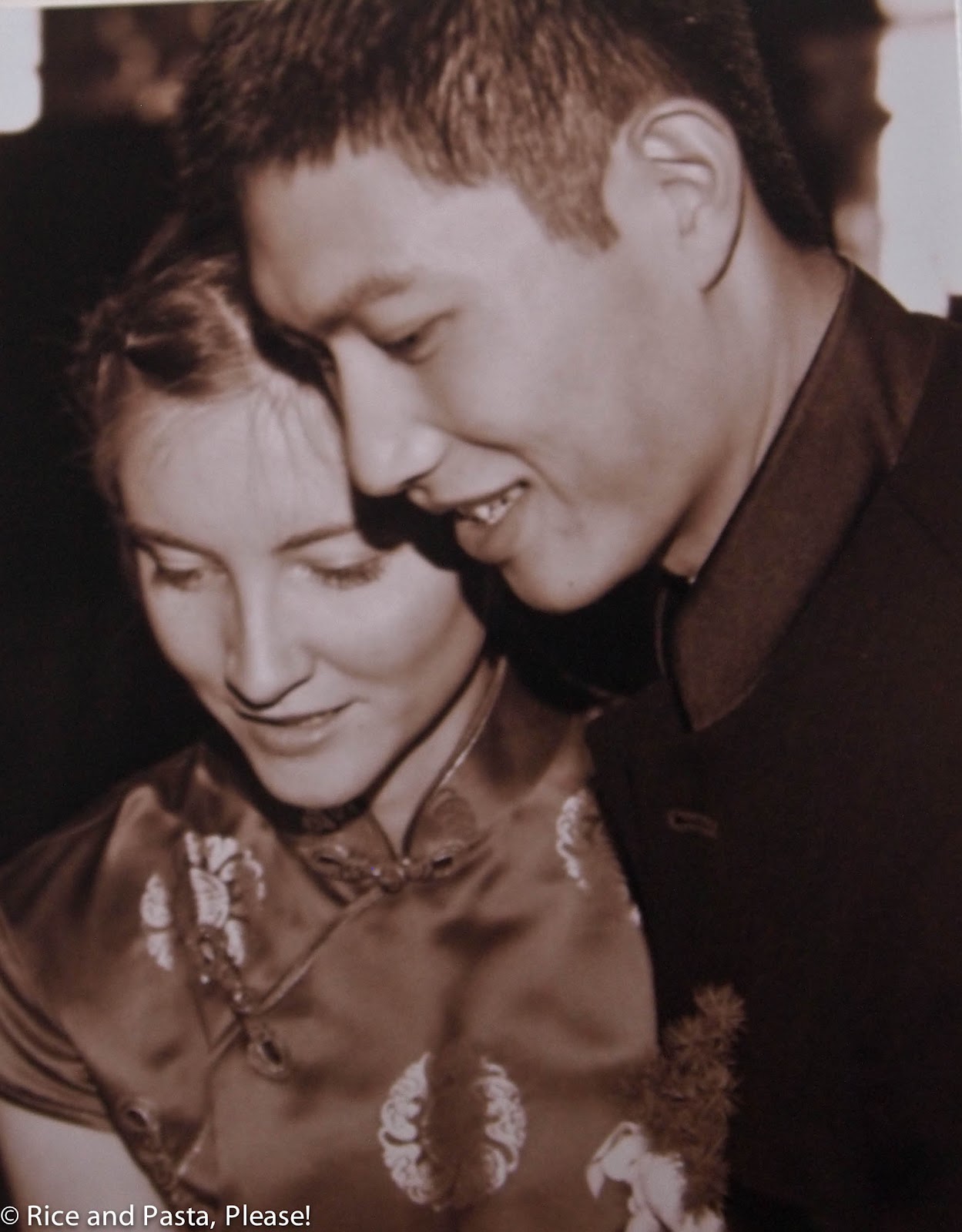
Last week my husband and I celebrated our tenth anniversary with a box of chocolates (from Pure Imagination Chocolatier in the North Market, Columbus for my Central Ohio readers...yum!). As I thought about years past, I realized that the love of good food has played a central role in our romance. 


I knew I was in love when on our first date, a tall, handsome Chinese man made me pasta with sautéed shrimp and set the table with linens and lit candles.  I was a vegetarian at the time, but his cooking was so good that I didn't bring up the subject until much later in our dating relationship (and then I happily converted back to an omnivore--my choice).  


Later, our dates revolved around finding the best fresh-roasted coffee beans and hand-rolled sushi in town.  We dined at fine restaurants and local food trucks, and cooked regularly for friends.


 When we planned our wedding, we capped our guest list at around 100 and held the event in the morning so we could afford to serve each of our guests tasty breakfast fare that included peach-stuffed french toast and smoked salmon. In order to afford a delicious cake, we skipped fondant and sugar decorations, and used extra flowers from the florist instead for decoration. 

After we married, we continued to pursue our growing gourmand tastes on a chicken-of-the-sea budget, eating simple noodle dishes throughout the week so we could afford a sushi splurge on the weekend or a yearly trip to our favorite local Japanese restaurant--that was the size of a shoebox and often had a line out the door.  


Ten years down the road, we still enjoy sharing good food. It's a passion, a hobby, a joy, but stronger bonds hold us together--our love for each other, our faith, and our children. In this season of life, we are enjoying teaching our kids to cook and introducing them to new tastes.  

Last night, all four of us watched spellbound as PBS chef Ming Tsai sliced a green papaya. The fact that we each found this simple but precise task amazing tells me that the pursuit of cooking and eating good food is something we will enjoy as a family for many years to come. 


Wednesday, August 29, 2012

The Grass is Greener!

...At least this is how I'm feeling after a much-needed trip out to the sunny (and foggy) California coast.

You probably heard about the drought we experienced in the Midwest this summer.  It was hot, scorching on most days and we went weeks on end with no rain.  This weather was punctuated by a fierce pop-up storm at the end of June that knocked out our power for a week when temps exceeded 100 degrees.  It's no surprise, then, that my my garden succumbed to it's miserable fate.


The zucchini and yellow squash were devoured by squash bugs (pictured left). The cucumber plant was ravaged by the cute yellow striped cucumber beetle. The green beans mildewed, and the tomatoes never ripened.  This left me with lots and lots of basil.


I knew that my dreams for my garden were naive, but I never dreamt that my only successful crops (other than the basil) would have been mosquitos and squash bug infestations.


This takes me back to California. To celebrate our 10th anniversary, my husband and I drove down to  Paso Robles and then over to the coast and up Highway 1 to San Francisco. On the way, we passed idyllic scenes of cows grazing in fields by the coast, farm stands piled high with gleaming produce, and green fields ripe with avocados and artichokes. 


Was the grass really greener in California?  The food fresher, tastier, and more beautiful?


While I'm sure that pests and extreme weather conditions are not unknown to farmers on the West coast, what we saw--the olives, grapes, tomatoes, eggplants, and peaches--looked perfectly magical compared to the drought-ravaged produce back home, and it made us think that just maybe, the grass was greener--at least this year--in sunny California.


Wednesday, June 27, 2012

Spice Cabinet Chinese Lessons


This past week when I needed space for a jar of newly dried basil from my garden, I found myself cleaning out my spice cabinet. I pitched sage, curry powder, and lemon pepper that was way past its prime, and then my fingers touched Chinese Five Spice Powder, or wuxiang fen (五香粉), which is a mixture of spices--most commonly star anise, cloves, cinnamon, Sichuan pepper, and ground fennel seeds.


I turned to my daughter who was nibbling on a snack, “Do you want to hear a funny story about your dad?”

I told her about how my dear husband, when we were first married, loved to cook but didn’t have much experience cooking Chinese dishes, despite growing up in Shanghai.  One day he tried making the ubiquitous Chinese dish Fish-fragrant Pork Slivers (Yuxiang Rousi, 香肉).  However, at some point in his youth, he misheard the name of the dish as Wuxiang Rousi, and as a result, thought that the defining spice used in this dish was in fact wuxiang fen, Chinese Five Spice Powder.

Well, fast-forward a few months, and my husband decided to make this new dish for his mother who was in town visiting.  After taking a bite, she exclaimed, “What did you put in here?” “Wuxiang fen,” he answered.  

“The dish is called Yuxiang Rousi not Wuxiang Rousi,” she laughed, barely able to get the words out of her mouth. And to this day, this story brings much laughter around his parents' dinner table.

“Do you get it?” I asked my daughter,  “Daddy confused the word wu, meaning five, with yu, meaning fish.” 

“Yeah,” she said, laughing to herself and repeating “wu and “yu.”

**********************************************************************************************************
If you’re wondering what Yuxiang Rousi is and how to make it, check out Moveable Feast’s adaptation of Sichuan food expert Fuschia Dunlop’s recipe: 
http://moveablefeast.wordpress.com/2007/03/30/mindblowing-fish-fragrant-pork-slivers-yu-xiang-rou-si/ 
and another recipe by Chef Wang:
http://traditionalchineserecipes.blogspot.com/2011/05/yu-xiang-zhu-rou-si-fish-fragrance-pork.html 
(I like his suggestion about putting the pork in the freezer before slicing; my father-in-law does this).

Thursday, June 14, 2012

"You want me to eat this?"


“Here, try this,” I handed my daughter a snow pea, just picked minutes ago from my garden and still hot from the stovetop where it was stir-fried.

“Eww,” she wrinkled up her nose.

I thought about my options.  I could force her to try it. I had done this with other foods in the past to little success.  My little drama queen would barely touch the dreaded food to her tongue, whine, gag, and then feign crying. 

“You don’t have to eat it, but I challenge you to try it,” I offered.

My daughter eyed me suspiciously and then brought the snow pea toward her lips. 

I looked down at my plate, pretending to take no interest in her vegetable-eating dilemma.

No longer than ten seconds later, I looked up.  The snow pea was gone and she was licking her fingers.  

“Where did it go?” I couldn’t hide my surprise.

“Oh, it was okay,” as she continued to lick her fingers.

I proceeded to tell my daughter that vegetables grown in a garden usually taste better than those bought in the store. Garden-grown vegetables have robust, complex flavors compared to their bland store-bought cousins. The snow peas tasted both lightly sweet and salty (I added salt when stir-frying), tender and at the same time crisp, and they tasted very green. I know that sounds strange but they tasted green. 

Last night I picked a handful of snow peas from the garden again to stir-fry for an evening snack.  My daughter watched me eat from the bowl of hot peas, and then put down her ice cream bowl to snatch one of the largest peas from me.  “Yum.  These snow peas are so good,” she said as she wolfed it down.


Basic Recipe for Stir-fried Snow Peas
  1. Wash snow peas and remove strings (just a personal preference).  Let air dry (this is important so the oil doesn’t splatter when you add the pods to the pan)
  2. Heat enough oil (I use canola) just to cover the bottom of your pan (I use a deep sauce pan to avoid oil splatters). High heat will scorch the pea pods so keep the temperature around medium-high. 
  3. Add the pea pods and stir or turn to coat each pod in oil (approximately 30 seconds).
  4. Add several tablespoons of water (The amount will depend on the number of pea pods you are cooking. The snow peas should not float in the water nor should the water be so little that it makes the oil “spit”)
  5. Cover the pan partially and allow the snow peas to cook an extra 2-5 minutes to taste (I like my snow peas a little crunchy so I tend to cook them less).  Add salt to taste approximately 30 seconds before you take the snow peas off the stove.  
  6. Serve immediately.
Enjoy!