Tuesday, March 27, 2012

Kids Cook! Egg Custard Tarts


With Easter just around the corner, I have eggs on the brain. My go-to egg recipes usually include quiche and breakfast casseroles. But what about the egg custard tart? This dim sum treat is typically not incorporated into the Easter spread at our house, but with its creamy, sweet custard center cradled in a flaky pastry crust, it's a perfect addition for spring.

Enlisting the help of my 3YO son, I tested a recipe for the tarts from The Young Chef’s Chinese Cookbook. This cookbook breaks down the tart recipe into eight delightfully simple steps. Pictures accompany each step, and show each ingredient and utensil used so you can’t go wrong.  A "Tips & Tricks" section (at the end of each recipe) lists essential info for each recipe. According to this recipe, the "trick" to making a perfect egg custard is to make sure that all ingredients for the filling (eggs, milk, and cream) are at room temperature--to avoid curdling during baking.

While some of the steps were too advanced for my 3YO (cracking eggs and measuring the liquid ingredients), he was able help with most of the recipe.


                       (beating the eggs and pressing the pie crust into tins)

We cooked the tarts an extra fifteen minutes to achieve a beautiful browned custard top (my oven temperature might be a little off--I need to check this). After waiting a painfully long amount of time, until they cooled completely, we taste-tested the tarts.  


      The verdict? Yum! A recipe we will try again.


The crust was crunchy and flaky, and carmelized where the the sugary-custard filling had spilled over the tart tins, while the center was smooth and creamy, sweet and rich (like a slighly-eggy Crème Brûlée). My son gobbled down the tart within two minutes, leaving me only crumbs to finish.  Thankfully, the recipe made five additional tarts (yield is not mentioned in the recipe) to savor over the next few days.   


Want the recipe?  Check out the Young Chef's Chinese Cookbook at your local library, or check out these links: Irvin Lin's Caramel Egg Custard Tart at "Eat the Love"  and Cantonese Egg Custard Tart at Christine's Recipes.  


What are your favorite egg-related recipes for spring? 


Friday, March 16, 2012

Keeping in Touch: Sharing Milestones through Facebook


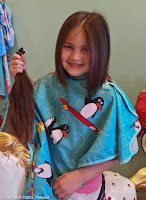
This week we celebrated two milestones in our family:  my son turned three and my daughter donated 12 inches of her shiny, brown hair to Wigs4Kids (a small non-profit in Michigan that provides wigs for kids with hair loss).  
We celebrated both events in our family of four (cake and presents for my son, hugs and pictures for my daughter), but longed to share the milestones with our extended family spread across the United States and China.

Thanks to iChat, we were able to connect with one grandparent (aka “Momish”) and one aunt and uncle.  In December, I posted about how iChat connected us with our family in China on Christmas Day.  Since then, we’ve discovered that this mode of communication is wonderful, when my mother-in-law has access to a good network connection in China (which isn’t often) and when we find the magic hour of the day when we are both awake (there is a thirteen-hour time difference).

This week, we summoned the power of Facebook to share highlights of my kids’ big days with several of our English-speaking extended family in Europe and Asia.  Although Facebook irks me (and others, I’m sure) on a regular basis due it’s frequent format changes, we are discovering it is a wonderful tool for keeping in touch with my husband’s English-speaking cousins. Prior to becoming Facebook “friends,” we kept in touch with my husband’s cousins pretty infrequently, whenever we made trips to China or through an occasional phone call. All of this changed minutes after I accepted their “friend” requests.

Now, they keep up-to-date with the latest goings-on in our household. They “like” my daughter’s new haircut and comment on my postings of my son’s latest antics. Cynics (or at least the cynical voice in my head) may say that this is only shallow communication, and that we're not connecting on a deep, meaningful level. Perhaps.  But we are communicating! And in a multi-lingual, multi-cultural family like ours (German, Japanese, Chinese, and American), communication on any level is remarkable and a step in the right direction.

How do you use Facebook to keep in touch with family who live in other countries? 

Tuesday, March 6, 2012

Children's Books about Chinese Food


How do you introduce your kids (picky eaters included) to new Chinese food in a fun, low-pressure way?  Read to them! Here are two of my favorite children's books about Chinese food that are sure to entertain both kids and adults, and might even make your tummy rumble!

For Young Readers (Picture Book):


 The Runaway Wok by Ying Chang Compestine (Penguin Dutton, 2011)

The Runaway Wok is the story of a poor peasant boy, Ming, who trades his family’s last eggs for a magic wok.  Soon the wok is galloping throughout Beijing stealing succulent dishes, toys, and money from the stingy but wealthy Li family, and depositing these goodies at Ming’s house. Ming’s family distributes the goods to the whole village, who then celebrate Chinese New Year together as the wok whisks the Li family out of town.  Parents will appreciate the author’s note about the Chinese New Year and recipe for Festive Fried Rice at the back of the book.  Kids will love the lively story and colorful illustrations.  If you like this book, check out Compestine’s The Runaway Rice Cake (2001), another Chinese New Year tale involving magic and food.


For Older Readers (Chapter Book):


 Dumpling Days by Grace Lin (Little, Brown, 2012)

In this sequel to Year of the Dog and Year of the Rat, heroine Pacy travels with her family to Taiwan to visit family and celebrate grandmother’s sixtieth birthday.  During the twenty-eight day visit, Pacy and her sisters share many new experiences: watching Chinese opera at a temple in Taichung, mailing postcards from the tallest building in Taipei, and sampling new foods at the night market.  In fact the entire book, as the title suggests, is full of food. Lin’s descriptions and illustrations of the new foods that Pacy tries will delight young and old alike: soft-skinned peach buns, steaming Chinese dumpling soup, crisp and sweet wax apples. The Lin sisters also experience Taiwanese culture through art classes that their mother has signed them up for.  These classes are initially a source of frustration for Pacy, who struggles with brush technique despite being “good at art” back in the United States.  The classes are a lens through which Lin depicts Pacy’s conflicted feelings about her Taiwanese-American identity--at times, the heroine feels like she doesn’t fit in and other times, she feels invisible (due to the language barrier), feelings that Lin resolves toward the end of the book.

In addition to Lin’s mouth-watering descriptions of food and her simple but poignant approach to cultural identity, I love the small illustrations that intersperse the chapters:  how to hold chopsticks (Chpt 2), instructions for making dumplings (Chpt 4), and a collection of all the different dumplings Pacy sampled (last page).  Also, your young reader will be tickled to see the small flipbook illustration of a crossing light on the corner of the each page. When you flip through the pages, the figure on the crossing light “walks” and the number counts down from forty to zero—brilliant!

If you like this book, check out Lin’s other books.  Themes of food run through her other chapter books, Year of the Dog and Year of the Rat, as well as her picture books, Dim Sum for Everyone, Bringing in the New Year, and Thanking the Moon.

What are your favorite children's books about Chinese food?  

Monday, February 27, 2012

Yuanxiao Makeover


After coming face-to-face with freezer-burned yuanxiao (sticky sweet rice balls) on the night of Lantern Festival, I vowed to learn how to make this Chinese dish.  Now, despite what the name of my blog suggests, I am not a natural cook (my husband is the cook in our house…but that’s a topic for another post!).  I love to eat good food, and really appreciate the magic in the kitchen that produces memorable meals.  But, sadly and despite my earnestness, I often fail to conjure such magic.

Take my latest experiment of making yuanxiao for example.  I followed RasaMalaysia’s recipe (minus the ginger syrup), and all was going splendidly until I took my first taste of the steaming dumpling.  It was salty!  I searched my mind, trying to figure out where I went wrong.  Salted butter! The recipe calls for unsalted butter, and in my haste, I grabbed the salted variety instead.  Oops.
 
I was determined to find a way to redeem this treat for my family (my poor daughter gagged after her first taste!)  And then the idea hit me, Nutella!  What is the magic hazelnut spread that makes all things taste yummy to a six-year-old? 

Nutella.

So, I remade RasaMalaysia's recipe, using Nutella instead of sesame paste as a filler (I stuck the jar in the freezer for a few minutes to stiffen the spread. Don't leave it in too long, though, or it will harden like concrete.)   

My yuanxiao, all rolled and ready to be boiled.


Three little yuanxiao. Aren't they cute?


And the result was....surprisingly delicious!  The Nutella filling in the cooked yuanxiao was warm and creamy, contrasting the thick, chewy mochi-textured outside.  Next time, I'm going to try a different rice flour (I used Koda Farms' Sweet Rice Flour this time) to see if I can make the outside layer thinner.  

What are your ideas for new yuanxiao fillings?

Monday, February 20, 2012

Review of Hessler's Country Driving


I recently finished Peter Hessler’s Country Driving, A Journey Through China from Farm to Factory, and have been mulling over what to say about this 400+ page tome. This book captures—in three acts—some of the huge changes (transformations, really) in rural China as the result of building new expressways and roads during the first decade of the twenty-first century.

Hessler, a longtime Beijing correspondent for The New Yorker and author of The Oracles Bones and River Town, divides Country Driving into three “books”--The Wall, The Village, and The Factory. Each of these “books” stand alone as complete stories, but read in succession, they paint a uniform portrait of the types of large-scale economic and social changes these roads are facilitating. 

In The Wall, Hessler documents his 7,000-mile trip as he follows the Great Wall (Changcheng) across northern China. A fact for your next game of Trivial Pursuit: The Great Wall is not one continuous wall built during one dynasty, but really a system of walled fortresses from many different dynasties (the Ming, Qin, Northern Wei, etc…) Hessler describes his adventures driving the City Special (a white Jeep with purple detailing) through remote regions, meeting locals who lead him to the ruins, and picking up hitchhikers who “pat the dog” (the motion for hitching a ride in China). The rich description of the physical geography and detailed history of the Great Wall are sure to be of interest to history and archeology buffs.

The Village focuses on Hessler’s six years in Sancha, a rural village north of Beijing. Early on, Hessler, who is renting a house in the village, becomes accepted into the local community after driving the sick child of local farmer Wei Ziqi to the hospital.  Hessler follows the changes in the small town after the local road is paved and tourists begin to the visit the countryside to experience “the simpler life.”  His friend Wei Ziqi (the farmer) is able to realize his dreams of becoming an entrepreneur by opening a guest house and restaurant. Television and packaged food becomes a staple in the house, and his friend purchases his first car.  But this new cash flow also has its downside. The town is unprepared to deal with the sudden increase in garbage, the previously small and underweight Wei child becomes overweight from packaged snacks, and Hessler's friend Wei Ziqi becomes stressed out from business deals. This sections leaves you wondering if the positives of the new highway actually outweigh the negatives.

In The Factory, Hessler follows the rise of a small bra ring (the metal components that hold a bra strap together—a picture would have been nice here!) factory in the Lishui Economic Development Zone, a newly opened area that is a sixty-minute drive (via the new Jinliwen Expressway) to the port city of Wenzhou. If you have ever wondered how a factory is started in China, this is the section for you.  Hessler takes you through the entire process, from construction of the factory and hiring of workers to manufacturing the first product and looking for the first customers. Later, he documents the factory’s move to Ouhai, another economic zone south of Wenzhou. This section addresses the complexities of underage workers in Chinese factories (Hessler’s wife Leslie Chang also looks at this issue in her book Factory Girls—another fascinating read), as well as the intricacies of “pulling guanxi” (la guanxi), a necessity of doing business in China.  One take-away from this section: The chemicals used to produce pleather  (you know, fake leather), which is also produced in Lishui, are so toxic that young women who have long-term exposure to it (DMF) are known to suffer liver damage and an increased risk of stillbirths. Yikes! I’ll buy real leather from now on, thank you.

This book is not for someone who is looking for a quick, light-hearted read, but if you want to better understand the changes that have happened in rural China in the last decade (yes, they've been huge and have had long-lasting social, economic, and environmental effects) and meet the people they have affected, then this is the book for you!

Friday, February 10, 2012

Lantern Festival and "Togetherness"


“Today is the last day of Spring Festival. You must cook yuanxiao for the children and light lanterns,” my mother-in-law called from China to remind me.

Spring Festival is the fifteen-day period in which the new lunar year is celebrated. Lantern Festival (or Yuanxiao Festival) marks the last day of the celebrations. At dusk on this day, families gather together to eat sweet or savory sticky rice balls (yuanxiao), light beautiful lanterns, and celebrate “togetherness” (tuanyuan). 

“Hao Aiyi (Youngest Aunt) waited in line to buy yuanxiao for four hours yesterday. That store on Huaihai Road (a famous commercial street in Shanghai) has the freshest yuanxiao in all of Shanghai.” She continued,  “And then she went to Yu Garden to buy a rabbit-shaped lantern for Da Yima (Eldest Aunt).”

Before we hung up, I told her that I’d try my best to share Lantern Festival with the kids.


How did this holiday sneak up on me?  It shouldn’t be a surprise; Lantern Festival happens every year at the same time—fifteen days after Chinese New Year. But here I was, again, ten minutes before bedtime looking at a package of freezer-burned yuanxiao. Memories of Mid-Autumn Festival came flooding back. 

I felt guilty for missing yet another Chinese holiday, but more than that, I felt sadness that all the yuanxiao in the world couldn’t bring my in-laws and us together to celebrate this holiday. My husband was out of town visiting my father-in-law, who was finishing up his last year of work before retirement, and my mother-in-law was in China caring for her sister, who was undergoing chemotherapy for colon cancer.

This weekend my husband will fly my father-in-law back for a short visit. Though my mother-in-law will not be able to join us, we will celebrate being together for a few short days.

And we might even eat yuanxiao!

How do you and your family celebrate “togetherness” during Lantern Festival?

Monday, January 30, 2012

Jiaozi-making Party


This weekend we invited friends over to celebrate the Year of the Dragon with us by making Chinese dumplings (jiaozi). This was our first jiaozi-making party since our college days, when we co-hosted a party for 20+ international students in our friends’ tiny apartment.

This year, since half of our guests were children under the age of seven, we wanted our party to be simple and kid-friendly. We used frozen dumpling wrappers from our local Chinese food store.  They defrosted on the counter in about two hours with the wrapper off. 


We made two different fillings, pork and shrimp and pork only, based on our friend Rob's recipe from years ago. 

Rob’s Dumpling Recipe

2 lbs of ground pork, turkey, or shrimp (We ground shrimp in our food processor.)
2 Tablespoons soy sauce
2 teaspoons salt
2 teaspoons black pepper
1 teaspoon white pepper
2 teaspoons of brandy, sherry, or other aromatic alcohol (We used Shaoxing cooking wine.)
1 teaspoon sesame oil

Mix all of the above together and let sit.

1 inch fresh ginger
3-4 stalks spring onion
Either 8-10 celery stalks or one small head of Chinese cabbage (Cabbage should be approximately 1/3 of meat mixture; we used about ½ of a large head for one recipe.)

Mince ginger, green onion, and cabbage, each separately. 
(A food processor works great for mincing Chinese cabbage, but we found that it needed to be cut into big pieces before being tossed into the processor to ensure uniform mincing.)

Squeeze excess water out of cabbage.

Mix minced veggies into meat and store in fridge until party.

Makes filling for around 90 dumplings. (We divided the recipe in half and used pork only for one half and pork and shrimp for the other.) 

Everyone helped with the wrapping, though the two-year-old’s dumplings were subjected to a second inspection to make sure the edges were totally sealed. Since our expert jiaozi maker from Beijing wasn’t able to come and instruct us, we experimented to find the best way to crimp and seal the dumpling wrappers.  This experimentation resulted in beautiful creations subsequently named “the stegosaurus” and “the full moon.” 

                                
(Above, the "stegosaurus," "the wave," and "the purse")

When the dumplings were ready to eat, we set them out with other simple dishes: cool cucumber salad, a tofu dish, stir-fried bok choy (qing cai), and white rice.  We also provided kid-friendly food such as “fishie” crackers, juice boxes, and berries.  After dinner, the kids scampered off to play while the adults enjoyed cherry pie, fresh whipping cream, and spiral jade tea.

All in all, it was tremendous fun, and my daughter is already talking about next years’ party.  I think we will add a vegetarian filling to the line-up as well as a contest (and award, of course) for the most creative wrapping style.  For those of you who want to get a head start on the competition, the filling must stay within the wrappers.

If you are planning to host a dumpling-making party this weekend, check out Carolyn Phillip’s wonderful recipes and instructional video. Also check out Kelly the Overthinker’s dragon cake.  So cute! I wish I had discovered this one last week.